

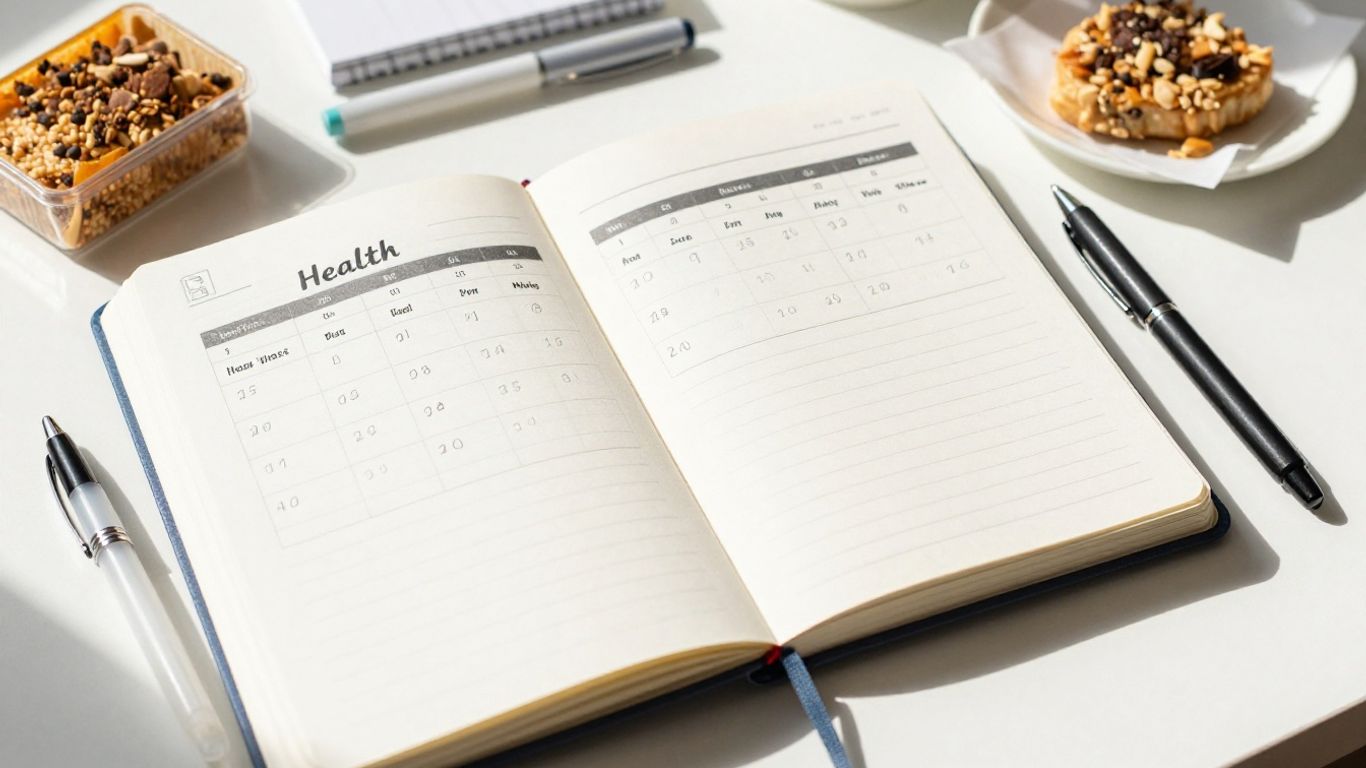
A personal editorial calendar for health borrows a simple idea from publishing: decide your themes in advance, give them fixed slots in your week, and repeat them at a steady cadence. Instead of trying to fix everything at once, you focus on one health theme per month, protect a few weekly time slots for it, and review regularly. The result is a plan that feels lighter and is easier to keep.
The three building blocks
| Element | What it means for your health | Example |
|---|---|---|
| Themes | The focus area for a month or season | “Vegetables at lunch,” “Strength twice a week,” “Earlier bedtime” |
| Slots | Recurring times in your week reserved for theme actions | Sunday 4:00 meal prep, Tuesday and Friday 7:00 a.m. strength |
| Cadence | How often you act, check in and change themes | Daily small actions, weekly review, new theme monthly |
Step 1: Choose your themes
Themes work best when each one is narrow enough to act on and connected to what matters to you. Start with the broad areas most people care about, then pick one specific behaviour inside each:
- Eating: Canada’s food guide suggests making half your plate vegetables and fruits, a quarter whole grains and a quarter protein foods (Health Canada). A theme could be “half-plate vegetables at dinner.”
- Movement: The Canadian 24-Hour Movement Guidelines recommend at least 150 minutes a week of moderate to vigorous activity, muscle strengthening at least twice a week, and breaking up long periods of sitting (CSEP). A theme could be “two short strength sessions a week.”
- Sleep: The same guidelines recommend 7 to 9 hours of good-quality sleep with consistent bed and wake times. A theme could be “same wake time every day.”
- Stress and mindset: A theme could be “a 10-minute walk or quiet break after work.”
Choose one theme per month to start. If you are already steady in an area, you can run a second, lighter theme alongside it.
Step 2: Map themes across the year
Sketch twelve months on one page and assign a theme to each. Seasons can guide your choices:
- January–February: Indoor movement and warm, simple meals like soups and stews.
- March–April: Lunch planning and adding more vegetables.
- May–June: Outdoor walking and active weekends.
- July–August: Hydration with water and simple summer meals built around seasonal produce.
- September–October: Back-to-routine: meal prep, consistent bedtimes.
- November–December: Stress care, sleep and keeping a minimum version of your habits through busy weeks.
Treat this as a draft. You can swap months when life calls for it.
Step 3: Assign weekly slots
A theme without time on the calendar tends to stay an intention. Give each theme two to four specific slots per week. Habits form when a behaviour is repeated in the same context, so the more consistent the time and place, the more automatic it becomes (Gardner et al., 2012).
Here is a sample week for a “vegetables at lunch” theme:
| Day | Slot | Action |
|---|---|---|
| Sunday | 4:00–4:30 p.m. | Wash and chop vegetables, cook a pot of grains |
| Monday–Friday | Evening, after dinner | Pack tomorrow’s lunch (5 minutes) |
| Wednesday | Lunch | Try one new vegetable or recipe |
| Saturday | Grocery run | Restock produce from a short list |
For help protecting these slots on hectic days, see time-boxing health habits.
Step 4: Set your cadence
Cadence is the rhythm that keeps the calendar alive. A simple structure:
- Daily: One small action from your current theme.
- Weekly: A 10-minute review. What happened, what got in the way, and one change for next week.
- Monthly: Decide whether to keep the theme another month or move on. Carry forward the parts that became easy.
- Quarterly: Look at the bigger picture. Are your themes still the right ones?
The NIDDK encourages people to review their plans, look at how well they are meeting goals and plan ahead for setbacks (NIDDK). Your weekly review is where that happens. Our habit reflection system has a ready-made set of questions.

Step 5: Add detail to each entry
A little detail turns a calendar slot into an easy decision. For each slot, note:
- What exactly: “20-minute bodyweight circuit,” not “exercise.”
- Where: Living room, local park, kitchen counter.
- What you need: Shoes by the door, groceries on the list, containers ready.
- Minimum version: The smallest version you will do on a bad day, such as a 5-minute walk.
Step 6: Build in buffers and flexibility
A calendar that only works in perfect weeks will not last. Leave room for real life:
- Plan for about 80 percent of your available time and keep the rest open.
- Keep one “flex slot” a week to catch up on anything that was missed.
- During travel, illness or busy seasons, switch to minimum versions instead of dropping the theme.
- Expect some missed days. Missing an occasional day does not undo habit formation, according to the habit research reviewed by Gardner and colleagues.
Sample one-month plan
Theme: Strength twice a week.
- Week 1: Two 15-minute sessions (squats, wall push-ups, glute bridges). Set out a mat the night before.
- Week 2: Same sessions; add one extra set if it felt easy.
- Week 3: Try 20 minutes or add a resistance band.
- Week 4: Keep the routine and review. Decide whether to continue next month or keep it as a maintenance habit while starting a new theme.
Common pitfalls
- Themes that are too broad. “Eat healthier” is hard to schedule. “Fruit with breakfast” fits neatly into a slot.
- Slots with no setup. A Tuesday walk slot works better when your shoes and jacket are ready by the door.
- Dropping a theme too early. Habits often take weeks to feel automatic, so give a theme at least a month before judging it.
- Losing earlier wins. When you start a new theme, keep a minimum version of the last one going so it does not fade.
- Planning instead of doing. If the calendar itself takes more than 30 minutes to set up, simplify it.
When to check with a professional
If you have a health condition, are pregnant, or are new to exercise, check with your healthcare provider before starting a new activity theme. A registered dietitian can help you build eating themes around medical needs, allergies or specific goals.
Takeaways
- Pick one health theme per month, narrow enough to act on.
- Give it two to four fixed weekly slots with a clear time and place.
- Run a simple cadence: daily action, weekly review, monthly theme decision.
- Note a minimum version for every slot so hard weeks still count.
- Leave buffers and adjust the calendar whenever life changes.
FAQ
Can I use a regular calendar?
Yes. A paper planner, a wall calendar or your phone calendar all work. Colour-coding themes can make the week easy to scan.
What if I fall behind?
Skip catching up. Restart with the next scheduled slot and use your weekly review to see what made the week hard.
How many themes is too many?
For most people, more than two active themes at once becomes hard to manage. Let one become routine before adding another.