

Time-boxing health habits means giving each habit a fixed block on your calendar with a clear start and end, then treating that block like any other appointment. The habit fills the box, and when the box ends, you stop. Pair those blocks with buffers, small gaps of unscheduled time, so a late meeting or a slow morning does not knock your whole day over.

Time-boxing versus time-blocking
The terms are often used interchangeably, but there is a useful difference:
| Time-blocking | Time-boxing | |
|---|---|---|
| Main idea | Reserve time for a type of activity | Set a fixed limit for a specific task |
| Example | “Tuesday 6–7 p.m. is for exercise” | “Strength circuit, 6:00–6:25 p.m., then done” |
| Strength | Protects space in your week | Makes tasks feel finite and easier to start |
For health habits, combining both works well: block the time, then box the task inside it.
Why it helps health habits stick
- Consistent cues. Habits form when a behaviour is repeated in the same context, so the cue starts to trigger the action with less effort (Gardner et al., 2012). A recurring time slot is a reliable cue.
- A clear finish line. “Walk for 20 minutes” is easier to start than “get more exercise.”
- Small blocks count. Mayo Clinic notes that being active for short periods during the day can add up and have health benefits, and that any amount of activity is better than none (Mayo Clinic). A 15-minute box is worth protecting.
- Fewer daily decisions. When the time is already set, you are not negotiating with yourself every afternoon.
Step 1: List your health habits and estimate time
Write down the habits you want to protect this week and an honest time estimate for each. Add a few minutes for setup and clean-up, which people often forget.
- Morning walk: 20 minutes plus 5 to get ready
- Strength session: 25 minutes
- Lunch prep for tomorrow: 10 minutes
- Weekly meal plan and grocery list: 30 minutes
- Wind-down before bed: 30 minutes
Step 2: Place the boxes
Put each habit in your calendar at a time that fits your energy and commitments. A few guidelines:
- Attach boxes to existing anchors: after breakfast, before leaving work, after dinner.
- Put the habits that matter most in the times you are least likely to be interrupted, often early morning.
- Keep the same times each week where you can. Mayo Clinic recommends going to bed and getting up at the same time every day, including weekends (Mayo Clinic), so a fixed wind-down box is a good place to start.
Sample weekday
| Time | Box |
|---|---|
| 6:45–7:10 a.m. | Walk |
| 7:10–7:20 a.m. | Buffer |
| 12:00–12:30 p.m. | Lunch away from the desk |
| 5:30–5:45 p.m. | Buffer / transition home |
| 7:30–7:40 p.m. | Pack tomorrow’s lunch |
| 9:45–10:15 p.m. | Wind-down: screens off, lights low |
Step 3: Protect the blocks
A box only works if you show up for it. Ways to guard your time:
- Name it on your calendar. “Strength, 25 min” is harder to overwrite than an empty space.
- Prepare the night before. Shoes by the door, ingredients on one shelf, mat unrolled.
- Use a timer. A kitchen or wall timer keeps you inside the box without checking your phone.
- Say no kindly. “I have something at 6:00, can we do 6:30?” is a complete answer.
- Move, don’t delete. If a box must go, drag it to another slot the same day or week.
Step 4: Respect the buffers
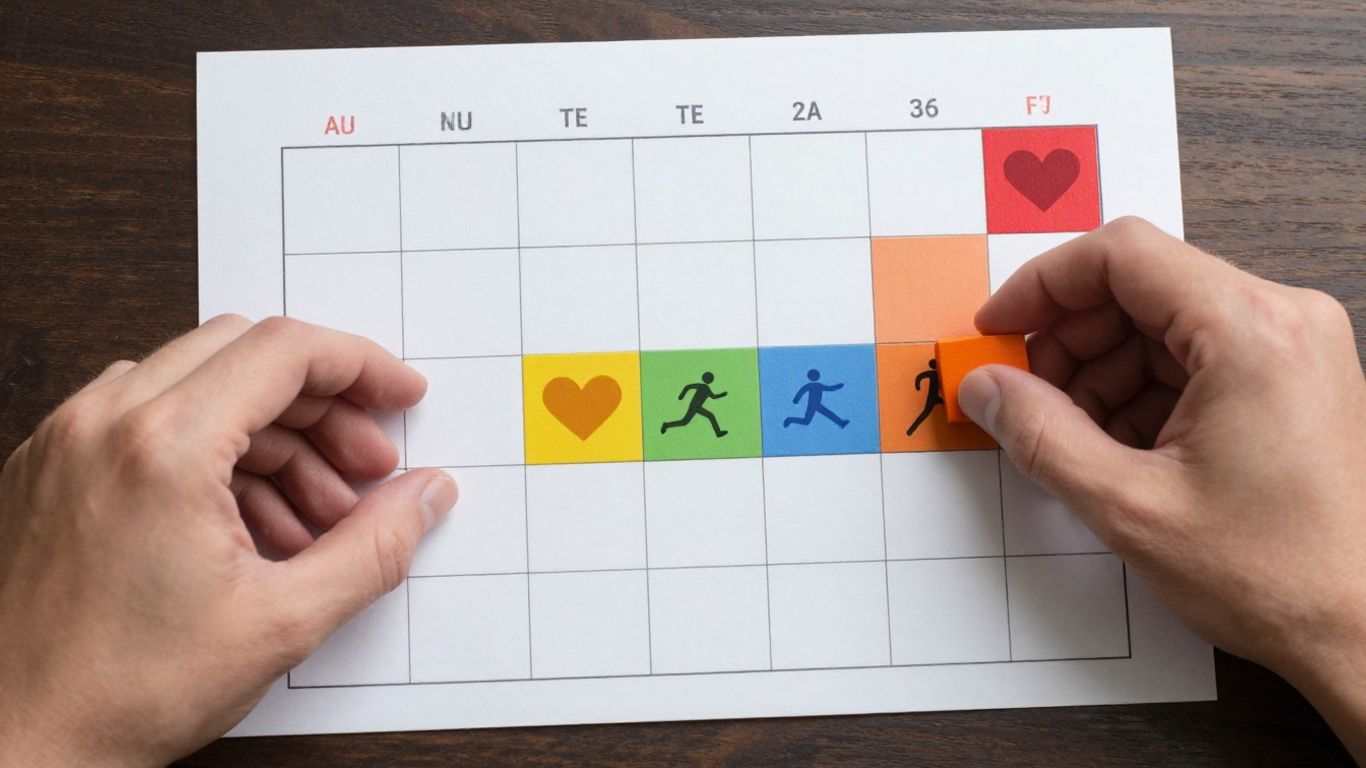
Buffers are what make a time-boxed schedule realistic. Without them, one delay pushes every box later until the evening habits disappear.
- Transition buffers: 10–15 minutes between commitments, especially before and after work.
- A daily flex block: 30 minutes with nothing scheduled, to absorb overruns or catch up on a missed habit.
- Weekly slack: Plan for about 80 percent of your time. Leave the rest open.
- Unscheduled rest: Not every free hour needs a box. Downtime is part of a healthy week.
When a box gets interrupted
- Pause, don’t panic. Handle what came up.
- Use the minimum version. A 25-minute workout becomes 10 minutes; a full meal plan becomes three dinners.
- Use your flex block if there is one later in the day.
- Reset at the next box. One missed habit does not cancel the rest of the day. Missing an occasional day also does not seriously disrupt habit formation, according to the research reviewed by Gardner and colleagues.
Keep a few shortened routines ready for these moments. Our minimum viable workout templates and five-minute balanced meals are designed for exactly this.
Batch similar health tasks
Switching between unrelated tasks takes time and attention. Grouping similar health tasks into one box makes each one faster and frees up the rest of your week.
- Food admin box (30 minutes, weekly): Plan dinners, write the grocery list and place an online order if you use one.
- Kitchen prep box (45 minutes, once or twice a week): Cook grains, wash vegetables, portion snacks and pack two days of lunches.
- Health admin box (20 minutes, monthly): Book appointments, refill prescriptions and update your calendar with upcoming visits.
- Movement box (25 minutes, two to three times a week): Strength work, with your mat and bands already set out.
The Canadian 24-Hour Movement Guidelines recommend at least 150 minutes a week of moderate to vigorous activity and muscle strengthening at least twice a week (CSEP). Two or three movement boxes plus a few daily walks cover a good share of that.
Common pitfalls
- Over-scheduling. Boxing every minute, including leisure, makes the plan brittle and tiring.
- Underestimating time. If a box regularly runs over, make it bigger or the task smaller.
- Being too rigid. The calendar serves you. Swap boxes when your energy or day changes.
- Tool hopping. A basic calendar and a timer are enough. Spending hours on the perfect app is a form of putting things off.
Weekly review
Spend 10 minutes at the end of the week looking at which boxes held and which did not. Ask:
- Which boxes happened most reliably, and why?
- Which ones kept getting bumped? Is the time wrong, or is the box too big?
- Did my buffers absorb the overruns, or do I need more?
Then adjust next week’s calendar. The habit reflection system offers more questions if you want a fuller review.
Takeaways
- Give each health habit a named calendar box with a start and end time.
- Tie boxes to existing anchors and keep times consistent from week to week.
- Build in transition buffers, a daily flex block and weekly slack.
- When a box is interrupted, shrink the habit instead of skipping it.
- Review weekly and resize boxes that keep overrunning.
FAQ
What if I don’t finish a habit within its box?
Stop anyway and note where you left off. If it happens often, give the habit more time or break it into two boxes.
Should I time-box fun activities?
Only if it helps you protect them. Many people prefer to leave hobbies and rest unscheduled.